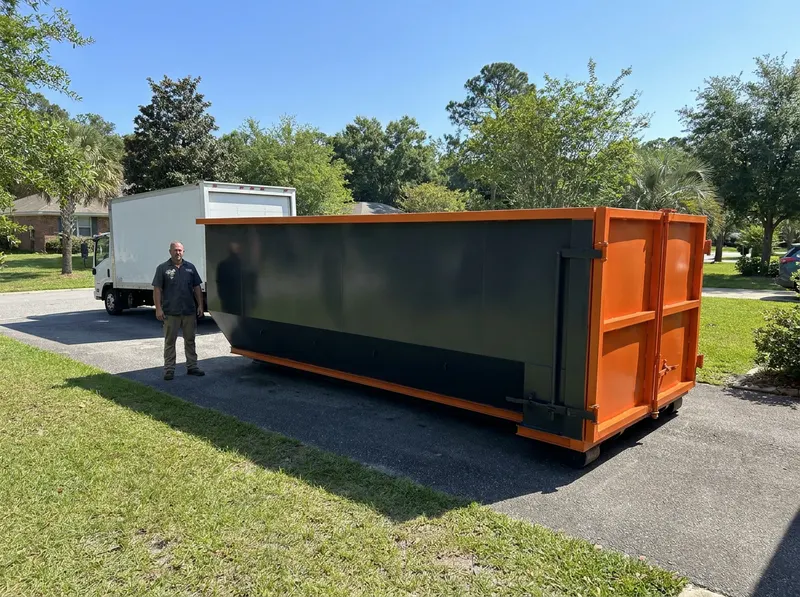
The 30-yard is the second-largest roll-off Clearspan Dumpster Rental runs, sitting between the 20-yard ($695) and the 40-yard ($895). All five sizes carry one flat price: 10-yard $595, 15-yard $650, 20-yard $695,…
The 30-yard is the second-largest roll-off Clearspan Dumpster Rental runs, sitting between the 20-yard ($695) and the 40-yard ($895). All five sizes carry one flat price: 10-yard $595, 15-yard $650, 20-yard $695, 30-yard $795, 40-yard $895. The $795 covers delivery, pickup, and disposal in one number, there is no back-end tonnage ticket or fuel surcharge added after the haul, which is where many construction and demolition waste invoices quietly climb.
The crucial non-obvious fact: a flat price shifts the weight risk to the hauler, so a heavy mixed load does not change the $795.
Step 1 is a quick size check, call or text a photo of the pile. Step 2, the container is scheduled, usually for the next business day. Step 3, the roll-off is set on a flat spot, ideally a driveway or hard pad.
Step 4, the bin is loaded over the days of the rental. Step 5, pickup is scheduled when it is full or the job wraps. A dumpster rental is self-load: the customer or their crew fills it, which is the key difference from junk removal where a team does the lifting.
A 30-yard fits a full roof tear-off, a whole-home cleanout, a large deck demolition, or a multi-room renovation.
A roof tear-off in East Hill or North Hill, neighborhoods heavy with older homes and layered asphalt shingles, can run a 30-yard close to full on its own. For a single-room remodel in Cordova Park or a garage purge in Ferry Pass, the 20-yard usually does the job for $100 less; stepping up to the 30-yard only earns its price when debris volume beats roughly 8 pickup loads. The trade-off is driveway footprint against capacity: the 22-foot box needs clear overhead and about 60 feet of straight approach for the truck, which matters on the narrow lots around Warrington, Brownsville, Myrtle Grove, and Bellview.
Weight limits still matter even with flat pricing.
Dense material, concrete, brick, dirt, roofing tile, or wet drywall from Scenic Heights or near Pensacola Beach after storm work, can overload a 30-yard before it looks full; the safe practice is to half-fill a 30-yard with heavy debris and let bulky light trash fill the rest. Loads must stay level with the top rail so the container can be legally tarped on the road under federal cargo securement rules. Certain items are banned from the open-top entirely: liquid paint, automotive fluids, tires, propane tanks, batteries, and electronics are classed as household hazardous waste and are kept out.
Appliances with refrigerant fall under EPA Section 608 refrigerant rules and need separate handling.
On a public street rather than a private driveway in Cordova Park or along the approaches to the Pensacola Bay Bridge, a right-of-way placement permit from the City of Pensacola or Escambia County may be required before the roll-off is set; a driveway drop needs no permit. Jobsite placement and loading around a working crew follow OSHA construction standards, and sorting recyclable debris out of the mix is supported through local drop-off guidance on Earth911. Shingle and roofing waste streams are tracked by the National Roofing Contractors Association, and broader demolition-debris practice is covered by the Construction & Demolition Recycling Association.
Yard and vegetative debris from a lot clearing near the University of West Florida is handled separately from the roll-off; general disposal rules trace back to the federal Resource Conservation and Recovery Act.
Every job gets a firm, written price after an on-site visit.
Tell us about your 30-yard dumpster rental job in Pensacola and we'll send a clear, written quote, usually the same day.
 Clearspan Dumpster Rental